VISIT OUR FACEBOOK PAGE!
Flavius Josephus: Ancient Rome's Jewish Historian
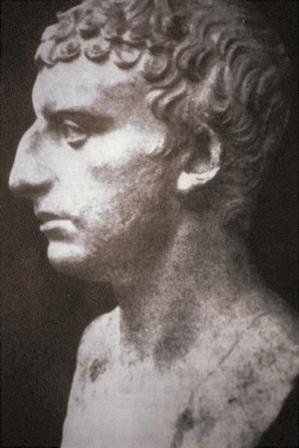
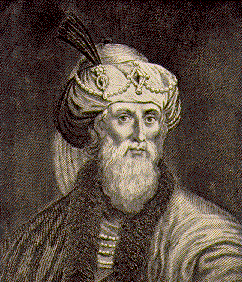
The great Jewish historian Flavius Josephus, known simply as Josephus, left an indelible influence on the history of the Jewish people, particularly around the time of Christ. Josephus was a contemporary of Jesus, yet wrote from a Roman persuasion.
One of the major criticisms of Josephus is that he cozied up to the Roman elite, leaving behind his Jewish brethren. At one time a Pharisee, another a Jewish general, and yet another a Roman patron, Josephus was a Renaissance Man of his time.
Interestingly enough, Josephus is the earliest author outside of the Bible to mention Jesus. In his seminal work, Antiquities of the Jews, written in about 94 CE, Josephus talks about Jesus. The passage in which he refers to Jesus is commonly known as the Testimonium Flavianum.
3. (63) Now, there was about this time Jesus, a wise man, if it be lawful to call him a man, for he was a doer of wonderful works-a teacher of such men as receive the truth with pleasure. He drew over to him both many of the Jews, and many of the Gentiles. He was [the] Christ; (64) and when Pilate, at the suggestion of the principal men amongst us, had condemned him to the cross, those that loved him at the first did not forsake him, for he appeared to them alive again the third day, as the divine prophets had foretold these and ten thousand other wonderful things concerning him; and the tribe of Christians, so named from him, are not extinct at this day (The Antiquities of the Jews, Book 18, Chapter 3. From The Works of Josephus, translated by William Whiston Hendrickson Publishers, 1987)
Josephus & the Sons of God from Genesis 6
Josephus also believed in the theory that the Nephilim were fallen angels. This is clearly stated in Josephus' Antiquities of the Jews. Josephus, unknowingly, also attacked the theory which supposes the "sons of God" were descendants of Seth.
In chapter 3 of The Antiquities Josephus talks of the sons of Seth.
He praises Seth himself in chapter 3 saying; "Now this posterity of Seth continued to esteem God..".
However, Flavius Josephus goes on to talk of Seth's descendants straying from the path of their forefathers.
"...but in process of time they were perverted, and forsook the practices of their forefathers; and did neither pay those honors to God which were appointed them, nor had they any concern to do justice towards men."
Immediately after his depiction of the degradation of Seth's line, Josephus talks about the incident in Genesis.
"For many angels of God coupled with women, and begat sons that proved unjust, and despisers of all that was good, on account of the confidence they had in their own strength; for the tradition is, that these men did what resembled the acts of those whom the Grecians call giants."
A fascinating comparison is made in this passage to the Greek gods. Josephus states the Nephilim performed acts which were equivalent to the acts associated to the gods of Greek mythology.
The obvious question raises a very interesting scenario.
Josephus on Noah & the Nephilim
Were the Greek gods and Greek mythology grounded in historical stories of those Nephilim who had migrated to ancient Greece in the days of Noah?
The evidence may suggest just such a thing.
By all accounts, the Nephilim possessed divine, almost magical, powers. They were extremely powerful, smart and very influential. The Nephilim ruled over man while cohabitating with humanity. They took human women as their own and established their own offspring.
The Nephilim are strikingly similar to the Greek mythological gods, and seem to provide a foundation upon which such myths may have been built. They were certainly half-divine, half-human beings.
Josephus pictures Noah standing up to the Nephilim of his day, urging them to change their ways and pursue God. However, Josephus states the Nephilim did not listen to Noah.
Noah eventually fled the land with his family in fear of his life. Perhaps it was during this exiled period which Noah built the ark.
In any case, Flavius Josephus makes his opinion clear on the subject. The writings of Josephus were also in line with the prevailing opinions of ancient Israel .
The opinion was the "sons of God" in Genesis were, in fact, fallen angels. The offspring they produced, the Nephilim, were of such a wicked nature, all of mankind was corrupted by them.
Josephus also believed the Nephilim were remarkably powerful and intelligent, and that they provided a historical basis for the Greek mythological belief system.
Though the accuracy of Flavius Josephus has often been debated, as he often wrote to please certain audiences, he does provide valuable insights into the culture and beliefs of his era.
Share Your Thoughts on Josephus' View of the Nephilim. Do you study Josephus? Are you interested in his works? What are your thoughts about the Nephilim? Click on the link above to give us your insight, thoughts, comments, and questions!
FLAVIUS JOSEPHUS STUDY RESOURCES
The Flavius Josephus Home Page - josephus.org
Back to Flavius Josephus
Back to the Nephilim
Back to Home Page
Recent Articles


-
Map of Ancient Mesopotamia: Early Empires of the Ancient Near East
Sep 07, 26 08:37 AM
 Discover the map of ancient Mesopotamia. Learn about early civilization, key historical empires, major cities, and trade routes along the Euphrates.
 -
The Tabernacle: God's dwelling place among Israel from Sinai to David.
Sep 04, 26 03:06 PM
 Discover the Tabernacle, God's dwelling place among ancient Israel, from its wilderness origins under Moses, to the Ark's arrival in Jerusalem under King David.
 -
Old Testament Maps & Geography: Interactive Biblical Maps
Aug 24, 26 09:42 PM
 Explore interactive Old Testament maps and historical geography. Trace ancient Israel's journeys, tribal boundaries, and biblical events with detailed charts.
 -
The Genesis Flood: Inside Noah's 371 Days on the Ark
Aug 18, 26 12:35 PM
 Explore the Genesis flood: mighty waters that reshaped the earth, Noah's 150 days adrift, and the 371 days his family spent in the ark.
 -
The Gates of Jerusalem: Ancient History, Architecture & Significance
Aug 17, 26 03:32 PM
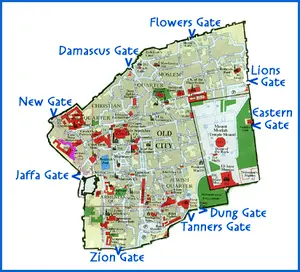 Explore the ancient gates of Jerusalem carved out of the ancient rock — Jaffa, Damascus, Golden Gate and more — their builders, history, and legends.
 -
The Tribe of Gad: History, Land Allotment & Biblical Maps
Jul 23, 26 07:45 PM
 Explore the Tribe of Gad in ancient Israel: land in Gilead, victories over Amorite kings, Levitical cities & their legacy in the history of Israel.
 -
he History of Flavius Josephus: A Chronicler of Ancient Israel
Jun 28, 26 08:47 PM
 Discover Flavius Josephus. Explore the life, historical writings, and lasting impact of the ancient Jewish historian who captured the fall of Jerusalem.
 -
History of the Ephraimites: The Rise and Fall of Ephraim in Israel
Jun 28, 26 07:45 PM
 Explore the history of the Ephraimites. Discover the origins of this powerful biblical tribe, their major conflicts, and their lasting legacy in ancient Israel.