VISIT OUR FACEBOOK PAGE!
Old Testament History
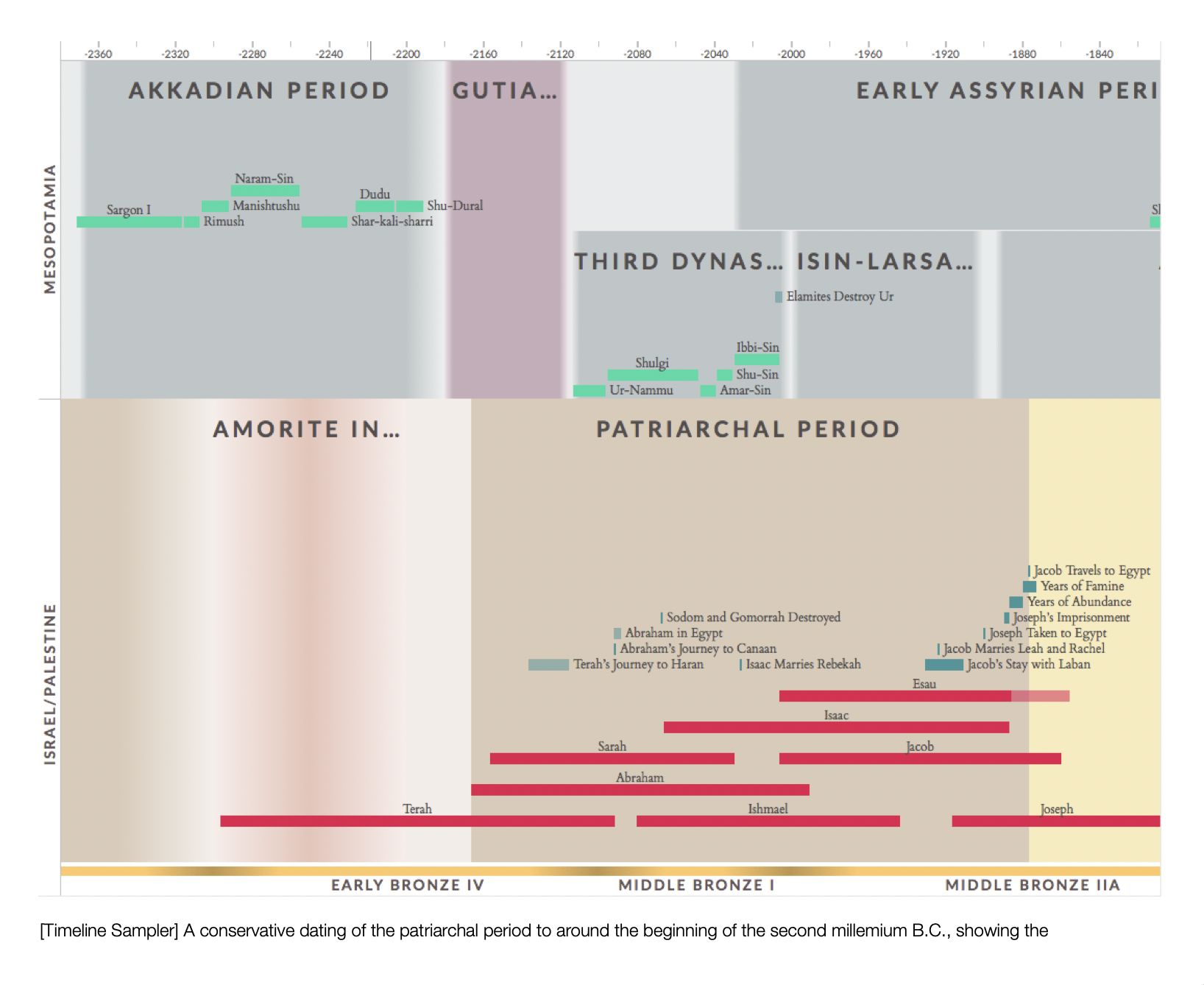
Old Testament history begins to correlate with known World history in the Bronze Age, ca 2500 BC. Abraham is the first character in the Old Testament that can be dated with any degree of certainty - though the dates of Abraham are not concretely known themselves. But based on the peoples, places and migration routes & patters of Abraham, and those he encounters, the narrative can safely be placed in the Early Bronze Age, circa 2000 BC.
`
ABRAHAM
The history of the Old Testament starts in Genesis, the book of beginnings, and traces God's people into the world of the Bronze Age. In the Early Bronze Age Old Testament history picks up with Abraham - or, Abram as he is first introduced in the Bible.
Abraham is believed to have dwelt around 2000 BC. The Bible records him first living in Ur, in southern Mesopotamia. The Great Ziggurat of Ur still stands today in the deserts of southern Iraq. Abraham would have walked in the shadows of this great pyramid over 4000 years ago!
God calls him forth from the land of Eden into the Promised Land of Canaan. Abraham would become the father of many nations - including Israel.
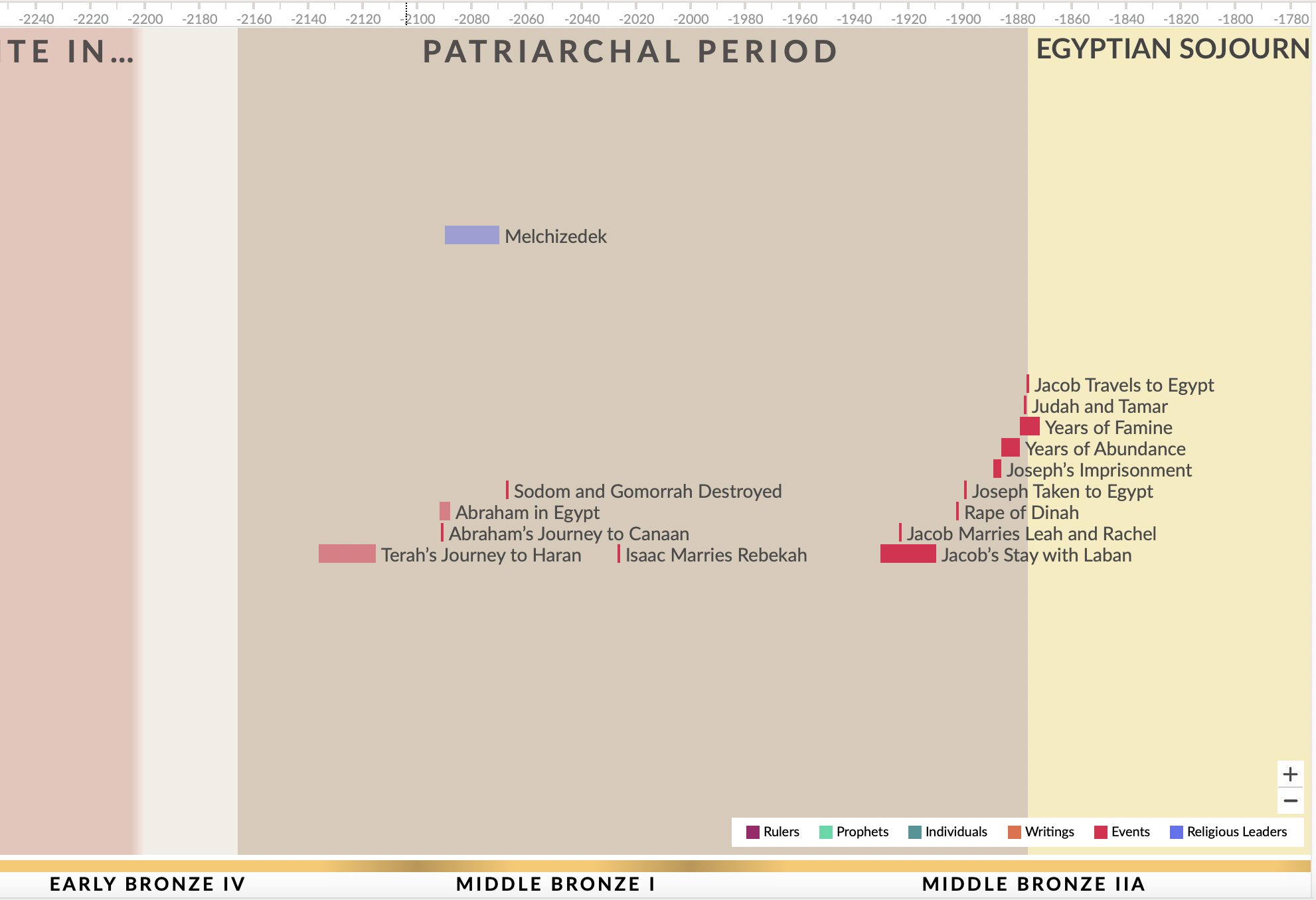
The narrative of Abraham, while not able to be proven with direct evidence, ie, evidence that points to THE Abraham or Lot, does fit nicely within the context of history. The places depicted in the Abraham narrative have been shown to be in existence just as described in the Bible by archaeology and other historical evidence. Thus the indirect evidence supports the narrative just as the Bible tells it.
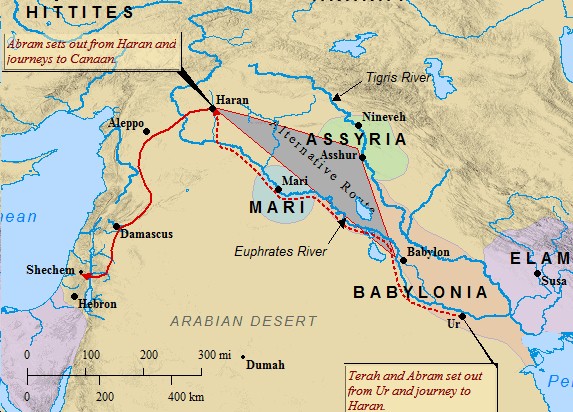
Abraham's journey from Ur to Canaan covered approximately 1,000 miles. He left his homeland following God's call. It was actually Terah, Abram' father, who led the family out of Ur. Terah was perhaps the initial recipient of God's call to leave Ur. However, they only made it to Haran and, for whatever reason, Terah settled there. It as from Haran Abram was called forth from his father's house.
`Abram and company's likely route out of Ur traveling north would've followed the Euphrates River. His route out of Haran traveling south to Canaan would have traversed the trade routes from Aleppo to Damascus and down the eastern banks of the Jordan River before entering the land of Canaan. Abram left Haran not knowing his ultimate destination. He simply followed God on faith.
As a reward of his faith Abraham became the father of many nations. Abram and his party entered Canaan first stopping at Shechem. From there he traveled to Bethel & Ai, eventually making his way south into the Negev.
Abraham's engage with the mysterious Priest of the Most High God is one of the most enigmatic events in the Bible. Genesis 14 records this even immediately after Abraham rescues his nephew Lot from a marauding army
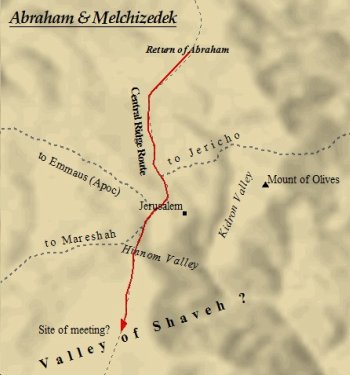
Abraham & Melchizedek met outside of Salem - nearly 1,000 years later it would be known as Jerusalem, the city of David. Melchizedek's identity remains a mystery.
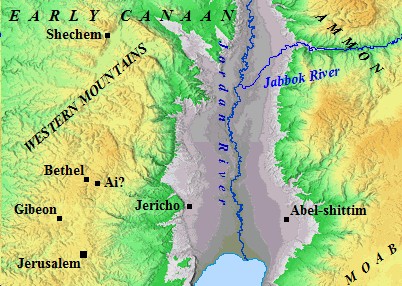
The Land of Canaan at the time of Abraham was populated with Canaanites. These people were descendants of Canaan, the son of Ham - one of the sons of Noah. Canaan was caught in the middle of the power struggle between Egypt and Mesopotamia.
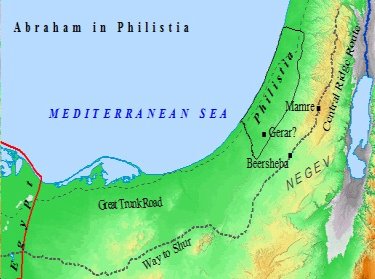
ABRAHAM IN PHILISTIA As he had done in Egypt, Abraham told Abimelech Sarah was his sister. The king took her only to be rebuked by God. It is interesting to note that Philistines were living in Canaan in the Bronze Age. They will reappear in the Biblical narrative as Israel's arch nemesis in the story of Samuel, Saul & King David. David eventually subdues the Philistines. Palestine is the modern remnant of these people. Palestine was the Roman word for Philistine.
Maps help one understand Old Testament history. They frame in a tangible way what the Bible is talking about. We can point to places where the famous events of the Bible took place. We can point to nations and countries that helped shape the world today. Maps bring into view what history obscures.
The ability to picture where an event took place helps to form a connection with the stories being told. Maps are invaluable tools to use when studying God's Word. When one realizes the events and people of the Old Testament lived in a very small area, and that area is still a part of that tradition today, it brings to life the Word of God.
Old Testament History
THE UNITED MONARCHY
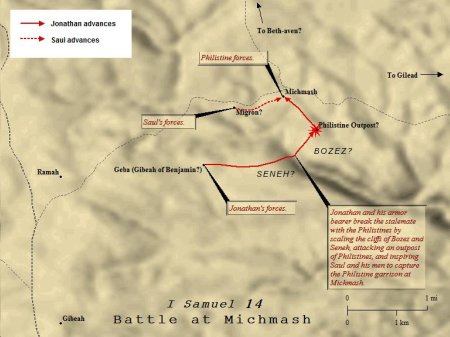
One of the most famous battles in Old Testament history, the Battle of Michmash was a glorious victory for Israel. Sparked by Jonathan, Israel under King Saul served the Philistines a major defeat.
Recent Articles


-
Map of Ancient Mesopotamia: Early Empires of the Ancient Near East
Sep 07, 26 08:37 AM
 Discover the map of ancient Mesopotamia. Learn about early civilization, key historical empires, major cities, and trade routes along the Euphrates.
 -
The Tabernacle: God's dwelling place among Israel from Sinai to David.
Sep 04, 26 03:06 PM
 Discover the Tabernacle, God's dwelling place among ancient Israel, from its wilderness origins under Moses, to the Ark's arrival in Jerusalem under King David.
 -
Old Testament Maps & Geography: Interactive Biblical Maps
Aug 24, 26 09:42 PM
 Explore interactive Old Testament maps and historical geography. Trace ancient Israel's journeys, tribal boundaries, and biblical events with detailed charts.
 -
The Genesis Flood: Inside Noah's 371 Days on the Ark
Aug 18, 26 12:35 PM
 Explore the Genesis flood: mighty waters that reshaped the earth, Noah's 150 days adrift, and the 371 days his family spent in the ark.
 -
The Gates of Jerusalem: Ancient History, Architecture & Significance
Aug 17, 26 03:32 PM
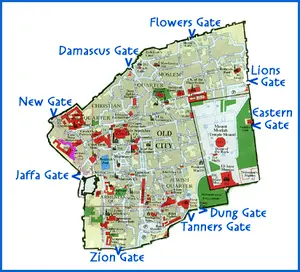 Explore the ancient gates of Jerusalem carved out of the ancient rock — Jaffa, Damascus, Golden Gate and more — their builders, history, and legends.
 -
The Tribe of Gad: History, Land Allotment & Biblical Maps
Jul 23, 26 07:45 PM
 Explore the Tribe of Gad in ancient Israel: land in Gilead, victories over Amorite kings, Levitical cities & their legacy in the history of Israel.
 -
he History of Flavius Josephus: A Chronicler of Ancient Israel
Jun 28, 26 08:47 PM
 Discover Flavius Josephus. Explore the life, historical writings, and lasting impact of the ancient Jewish historian who captured the fall of Jerusalem.
 -
History of the Ephraimites: The Rise and Fall of Ephraim in Israel
Jun 28, 26 07:45 PM
 Explore the history of the Ephraimites. Discover the origins of this powerful biblical tribe, their major conflicts, and their lasting legacy in ancient Israel.
 -
Enoch the Prophet: Ancient Secrets, Holy Scripture & Biblical History
Jun 24, 26 05:21 PM
 Study the life of Enoch the Prophet. Discover his close walk with God, his ancient biblical lineage, and the deep theological mysteries of his prophecy.
 -
History of Enoch: The Prophet in the Apocryphal & Biblical Texts
Jun 23, 26 09:41 PM
Uncover the history of Enoch. Explore the biblical patriarch's life, his walking with God, and the ancient mysteries behind the apocalyptic Book of Enoch.